We offer block paving driveway installation across the whole of Accrington, including Oswaldtwistle, Clayton-le-Moors and Church, as well as nearby Haslingden, Padiham and Rawtenstall. We design each new drive in Accrington to drain properly within the front-garden permeable-surface rules, and help with any dropped kerb application to Lancashire County Council.
Of all the driveway surfaces we install, block paving is the one that gives Accrington homeowners the most say over how the finished drive looks. Colour, block size, laying pattern, borders and edge details are all yours to choose, and Accrington Landscaping & Driveways lays all of it, from everyday concrete blocks to clay bricks and natural stone setts. This page explains the three types of block paving driveway installation we offer and how a flexible pavement is built. It is for anyone in Accrington planning a new drive or replacing a worn one.
Block paving is a flexible pavement. The blocks sit on a bed of sharp sand over compacted Type 1, and the jointing sand locks the surface together so it moves slightly as one under load rather than cracking. That is why a well-laid block drive can be lifted to repair a pipe and put back with no scar.
We lay to BS 7533, the British Standard for paving, because it is the difference between blocks that stay flat and blocks that rock, sink and sprout weeds. Every job comes with a written quote and a written guarantee.
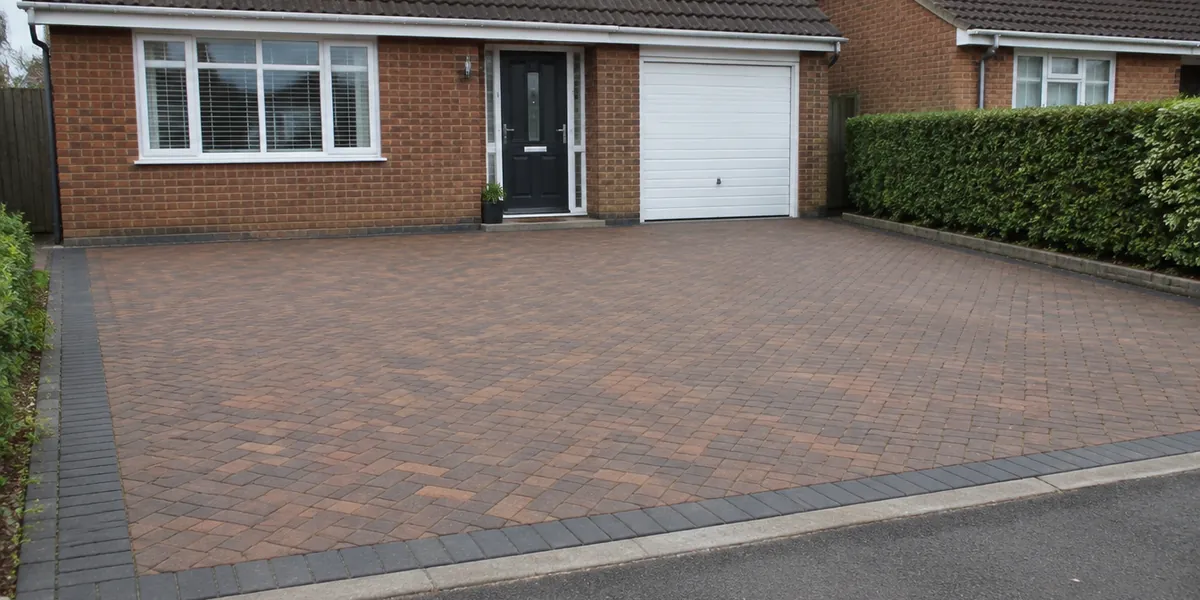
Where We Offer Concrete Block Paving Driveways
Concrete block paving is the mainstay of British driveways. It comes in a huge range of colours, from charcoal and brindle to buff and autumn blends, in sizes from the standard 200 x 100 mm rectangle to tumbled cobble-effect sets, and in thicknesses of 50, 60 and 80 mm. For a domestic drive we use 60 mm blocks for cars and 80 mm where a van or motorhome will stand.
It is the right choice when you want a decorative, long-lasting surface at a lower cost than clay or stone, with the option of a contrasting border, a centre panel or a circle feature. Permeable concrete blocks with spacer nibs and wider joints filled with 2 to 6 mm grit let rainwater soak through, making them a SuDS-compliant surface for front gardens.
Our standard build-up is 150 mm of compacted Type 1 MOT, a 30 to 40 mm screeded bed of sharp sand, then the blocks laid in a 45-degree herringbone for strength, cut in at the edges with a splitter or saw and compacted twice with a rubber-matted plate. Kiln-dried sand is brushed into the joints between passes until they are full.
What affects the result is the compaction of each layer, the consistency of the sand bed, the accuracy of the edge restraints and the quality of the block. Cheap blocks can vary in thickness, which shows up as a wavy surface, so we buy from manufacturers we know and check pallets as they arrive in Accrington.
Clay Brick Driveways
Clay paving bricks are fired, and the colour runs right through them rather than sitting in a surface layer. A clay brick driveway does not fade in the sun or wear pale under tyres; it weathers to a richer tone rather than a tired one. Reds, oranges, blues and multi-blends are the classic choices, and they suit Victorian and Edwardian houses, where a grey concrete block would look out of place.
Clay is the right choice when you want a traditional appearance that will still look traditional in thirty years, or when a conservation area or a listed building calls for materials sympathetic to the street. It is extremely hard-wearing and frost-resistant, provided the bricks are rated for exterior paving rather than being ordinary facing bricks.
Installation follows the same flexible method as concrete block paving, with adjustments. Clay bricks are slightly less consistent in size, so we allow wider joints of 3 to 5 mm and take more care screeding the bed. They are usually 50 or 65 mm thick, laid on 150 mm of compacted Type 1 and a 30 mm sand bed, in herringbone or basket-weave, a traditional pattern that suits a small front garden with light traffic.
The result depends on the grade of brick, the care taken over joint widths and the usual sub-base work. Clay is a step up in price from concrete and, for the right Accrington house, a step up in how long it looks good.
Natural Stone Driveways
A natural stone driveway uses granite, sandstone, limestone or basalt setts and cobbles rather than manufactured blocks. Nothing else gives the same depth of colour and texture, and a well-laid granite sett drive is about as permanent as a driveway can be. It is the premium option in our range, installed for Accrington homeowners with period properties, large frontages or simply a taste for stone.
Natural stone is the right choice when appearance matters more than budget and the drive is part of a wider garden design. Granite setts in silver-grey or black are the hardest and most consistent. Sandstone gives warmer tones and suits cottage-style houses. Tumbled cobbles give an old-town look but are harder to walk on.
The laying method depends on the stone. Calibrated setts of consistent thickness can be laid flexibly on sand like a block. Riven or hand-cut setts vary in thickness and are better bedded on a semi-dry mortar over a bound base, with the joints filled with a resin or slurry compound rather than sand, so the surface stays rigid and weed-free. Either way the sub-base is 150 mm or more of compacted Type 1 and the edges are restrained in concrete.
What affects the result is the sorting of the stone before laying, the skill of the person setting each piece, and allowing for the uneven surface in the falls so water does not pond. Stone is slower than concrete block paving, but it is the drive that gets the most compliments in Accrington.
Why Accrington Homeowners Choose Us for Block Paving Driveway Installation
Block paving can be done badly in ways that are invisible on the day of completion and obvious a year later. Too thin a sub-base, an unscreeded bed, blocks laid tight without jointing sand, an edge course set on dabs of mortar rather than a full concrete bed. We have lifted and relaid plenty of such drives in Accrington, and it is why we build to BS 7533 rather than by eye.
Our team has laid thousands of square metres of block paving across Accrington. We compact the sub-base in layers, screed the sand bed to a tight tolerance, use a herringbone bond for driveways and set every edge restraint on a concrete bed with haunching. We buy blocks from reputable manufacturers and check colour batches so your drive is not two shades.
You get an itemised written quote, a written guarantee on the installation, legal disposal of waste through our registered waste carrier status and a frank opinion if something else, such as resin driveway installation or gravel, would suit your plot or budget better.
Our Block Paving Driveway Installation Process
- Survey and design. We measure, check levels and drainage, and help you choose block type, colour, laying pattern and border details with samples on site.
- Written quote. The quote lists excavation depth, sub-base, edging, bedding, blocks and jointing so you can compare it with others line by line.
- Excavation. The ground is dug out to 250 to 300 mm below finished level and spoil is removed.
- Edge restraints. Kerbs or edging blocks are set on a concrete bed with haunching to the exact line and level of the finished drive.
- Sub-base and drainage. Type 1 MOT is laid and compacted in layers, with any channel drains, gullies or a soakaway installed and tested.
- Bedding and laying. A screeded bed of sharp sand goes down, and the blocks are laid to the pattern, cut in at the edges and checked for line and level as they go.
- Compaction and jointing. The surface is vibrated with a rubber-matted plate, kiln-dried sand is brushed into the joints and the surface is compacted again before handover.
A typical block paving driveway installation in Accrington takes between four and eight working days, depending on size, pattern complexity and the amount of cutting.
How Block Paving Driveway Installation Is Priced in Accrington
The block itself is the obvious variable. Standard concrete rectangles in a single colour sit at one end, clay bricks and natural stone setts at the other, with tumbled, textured and permeable concrete blocks in between. Block thickness, 60 or 80 mm, follows from what will park on the drive.
Pattern and detailing affect labour. A plain herringbone field is quickest. Adding a contrasting border, a soldier course around a manhole, a circle feature or curved edges increases cutting time and wastage. Natural stone laid rigid on mortar with resin jointing takes longer again.
Beneath the surface, the depth of excavation and sub-base depends on the ground in your part of Accrington and whether an old drive is being removed. Drainage work, new kerbs, a dropped kerb application, recessed manhole covers and access for deliveries all add lines to the quote. We set all of this out clearly so there are no surprises.
Block Paving Driveway Installation Around Accrington
Block paving works on almost any property, which is why we lay it everywhere: if your home in Oswaldtwistle has a compact period frontage, clay brick in a basket-weave pattern will suit it, and if your drive in Church is broad, there is room for a circle feature and a double border. Around Clayton-le-Moors we often replace cracked concrete with permeable concrete blocks to deal with standing water, and if you share access with the house next door in Great Harwood, a matched design keeps both neighbours happy. If your newer home in Huncoat came with builder's tarmac, we can swap it for something with a bit more character. We cover all of these and nearby Haslingden, Padiham and Rawtenstall.
Planning more than one job? Have a look at concrete driveway installation and tarmac driveway installation.
Common Questions
What is BS 7533 and why does it matter?
BS 7533 is the British Standard covering the design and construction of paving in blocks, setts and flags. It sets out sub-base depths, bedding sand thickness, jointing and compaction for a surface to perform under traffic. Laying to it is what stops blocks sinking, rocking or spreading, and it is how every block paving drive we install in Accrington is built.
How do you stop weeds coming up through a block paved drive?
Seeds blow into any joint and will germinate in the sand if left. A well-compacted drive with full joints gives them little to root into, and an annual sweep with a stiff brush, topped up jointing sand and the occasional spot treatment keeps them away. A polymeric or resin jointing compound can be used instead of sand to make the joints firmer.
Can a block paved driveway be permeable, and does it need to be?
Standard block paving with sand joints is treated as impermeable for planning purposes, so a front drive over 5 m² needs to drain to a lawn, border or soakaway. Permeable blocks with wider joints filled with grit over an open-graded sub-base let rain soak straight through and count as a permeable surface, which is often the simplest solution in Accrington.
Which laying pattern is strongest for a driveway?
Herringbone, at either 45 or 90 degrees, because the joints never run continuously in the direction a car travels, so the blocks cannot creep under braking and turning. Stretcher bond and basket-weave are fine for paths and light-use areas but can shift on a drive. We lay all driveway fields in herringbone unless the design calls for something else.
Can you lift and relay blocks if a pipe needs repairing?
Yes, and that is one of block paving's biggest advantages. The blocks over the affected area are lifted, the trench is dug and repaired, the sub-base is reinstated and compacted, and the same blocks go back on fresh bedding sand. Done properly the repair is invisible, which cannot be said of a patched tarmac or concrete drive.