We offer tarmac driveway repair across the whole of Accrington, including Church, Clayton-le-Moors and Huncoat, as well as nearby Haslingden, Padiham and Rawtenstall. Every quote in Accrington covers the base, edges and drainage as well as the surface, so you know what is causing the problem before you pay to fix it.
Tarmac drives are tough, but they are not immortal. Accrington Landscaping & Driveways is a local contractor repairing tarmac driveways for homeowners and landlords throughout Accrington. Our tarmac driveway repair service deals with potholes, cracks and crumbling edges, the three faults that account for nearly every call we get about a tarmac drive. It is aimed at anyone whose drive has started to break up in places but still has a sound base underneath.
Tarmac fails from the top down and from the edges in. Sunlight dries out the bitumen binder over the years and the surface goes grey and brittle. Water then gets into the small cracks, freezes in winter and opens them up. Cars turning on the same spot grind loose stone out and a pothole forms. Edges without a kerb or restraint simply crumble away under tyres.
Catch these problems early and the repair is small and cheap. Leave them and water reaches the sub-base, which is when the whole drive starts to move. We will tell you honestly which stage your drive is at and whether repair, resurfacing or replacement is the right spend.
Where We Offer Tarmac Driveway Crack Repair
Cracks are the earliest sign that a tarmac drive in Accrington is ageing. They start as fine surface crazing where the binder has oxidised, then develop into longer linear cracks, often following the joint where two days' laying met or along a line of ground movement. Alligator cracking in a patch usually means the base beneath has softened and that patch needs cutting out rather than sealing.
For linear cracks up to about 20 mm wide we clean the crack out with a wire brush and blower, dry it with a hot-air lance if needed, and fill it with a hot-applied rubberised bitumen crack sealant. The sealant is poured slightly proud, then banded flat with a squeegee so it sheds water. It stays flexible through winter, which is the point: a rigid filler will crack again by February.
Wider cracks are cut back to a clean edge with a disc cutter, primed with a bitumen tack coat and filled with hot-lay or cold-lay dense bitumen macadam, compacted with a vibrating plate or hand tamper. Where the cracking is widespread but the base is sound, sealing individual cracks stops making sense and we would suggest tarmac driveway resurfacing with a new wearing course instead.
Crack repairs are best done in dry, mild weather. We keep traffic off a sealed crack for a few hours and off a hot-lay patch until it has cooled fully, usually overnight.
Tarmac Driveway Pothole Repair
A pothole is what a crack turns into when it is ignored for a couple of winters. Water gets under the wearing course, the stone loosens, tyres pull it out and the hole deepens with every rain. On Accrington drives they tend to appear where a car turns or brakes, at the junction with the public footway, and anywhere a downpipe discharges onto the surface.
A proper pothole repair is not a shovel of cold-lay pressed in with a boot. We square the hole off with a disc cutter so the edges are vertical and sound, dig out any soft or waterlogged material and check the sub-base. If the Type 1 MOT underneath has gone soft it is removed and replaced, then compacted, because new tarmac on a soft base will fail again within the year.
The hole is primed with a bitumen emulsion tack coat so the new material bonds to the old. We then lay hot 6 mm dense bitumen macadam in layers of no more than 40 mm, compacting each one with a vibrating plate, and finish slightly proud so the final pass leaves the patch flush. For small, isolated holes a good-quality cold-lay macadam gives an acceptable result, but for anything larger than a dinner plate hot material lasts far longer.
Fresh black tarmac on a weathered grey surface will show at first. It dulls over a season, and we can seal the whole drive to even out the colour if that matters to you.
Tarmac Driveway Edge Repair
Edges are a tarmac drive's weak point. Tarmac has no strength of its own at a free edge, so where a drive meets a lawn, a gravel border or a flower bed without a kerb, the first time a tyre runs over the edge it breaks off. In Accrington we see this most on drives that were widened on the cheap or laid without any edging at all.
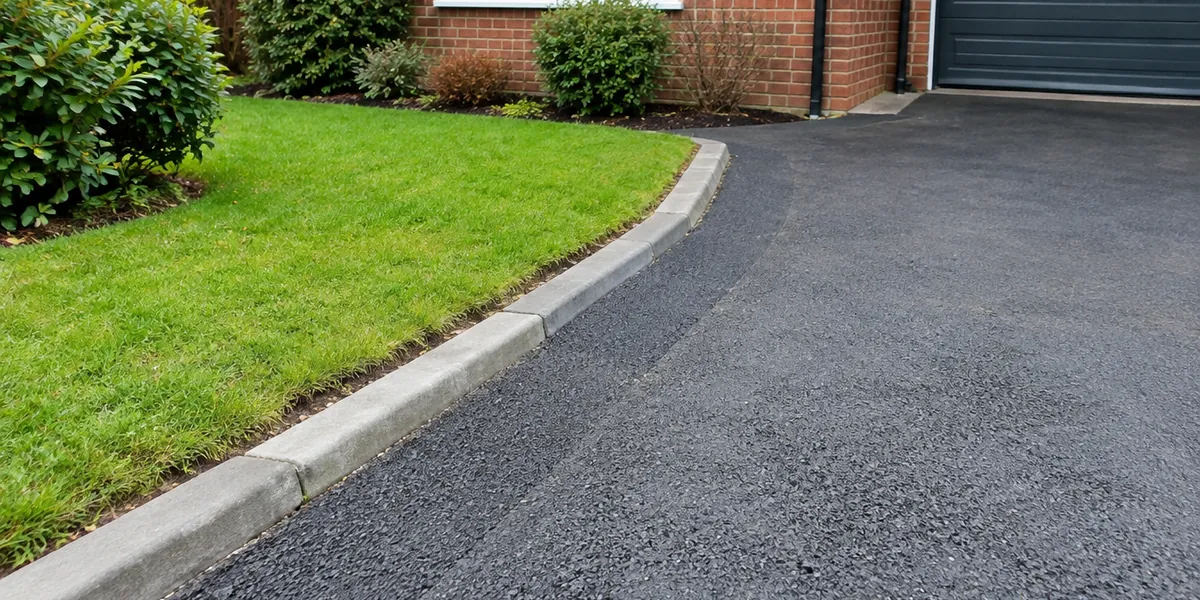
Edge repair starts with cutting the broken edge back to a straight, sound line. We then install a proper restraint. The most common choice is a concrete edging kerb or a line of block paving bedded on a concrete haunch, which gives the tarmac something solid to compact against and stops it spreading under load. Steel or aluminium edging is an option where you want the restraint to disappear visually.
Once the restraint is in and the concrete haunch has set, we make up any missing sub-base, prime the cut edge and lay hot dense macadam to bring the drive back to its full width. Compacting right up to a solid edge is what makes the difference; without it the new strip will crumble just like the old.
Edge repairs are often combined with pothole work on the same visit. If you are repairing edges, it is also worth asking us about drainage: a channel drain or gully at the low edge keeps run-off off the public footway and protects the repair.
What You Get When We Handle Your Tarmac Driveway Repair
Plenty of people will drive past, see a pothole and offer to fill it from the back of a van. We do not work like that. Accrington Landscaping & Driveways is a local firm with a fixed address, full public liability insurance and a written quote for every job before any work starts.
We use hot-lay macadam from a local plant for anything beyond the smallest patch, and we prepare properly: cutting back, replacing soft base, priming the edges. That preparation is the difference between a repair that lasts a winter and one that lasts ten, and it is why our repairs carry a written guarantee.
Because we also install new tarmac, block paving and gravel drives across Accrington, we can give you straight advice about where repair stops being good value. If your drive needs resurfacing or replacing we will say so and quote for both so you can compare.
How Our Tarmac Driveway Repair Works
- Inspection: we check the depth of damage, probe the sub-base and look at drainage and edges across the whole drive, not just the hole you called about.
- Written quote: an itemised quote for the repairs, with a recommendation if resurfacing would be better value.
- Cutting back: cracks, potholes and edges are cut to clean, square, sound edges with a disc cutter.
- Base repair: soft or wet sub-base material is dug out, replaced with Type 1 MOT and compacted.
- Priming and laying: edges are tack-coated and hot or cold macadam is laid and compacted in layers.
- Edging: where needed, new kerbs or edging are installed on a concrete haunch before the tarmac is laid.
- Finish and handover: the surface is checked for levels and falls, waste is removed and you receive the written guarantee.
Most tarmac driveway repairs in Accrington are completed in a single day. We avoid heavy rain and frost, and in high summer we work early to keep the tarmac workable.
What Affects the Cost of Tarmac Driveway Repair in Accrington
The number and size of the repairs is the starting point. One pothole and a few metres of crack is a quick visit; a drive with failing edges on both sides and a dozen holes is a different job. Depth matters as much as area, because a pothole that has reached the sub-base needs excavation and new stone, not just tarmac.
The material we use affects the price. Hot-lay macadam gives the best result but needs collecting from a plant and laying the same day, which only makes sense above a certain quantity. Cold-lay is fine for small patches.
Edge repairs cost more when a new kerb or edging has to be installed. Access in Accrington is a factor too: tight terraced frontages and shared drives take longer than an open drive with space for the van and plate compactor. Finally, if you want the whole drive sealed afterwards to blend the repairs in, that is priced as an extra.
Tarmac Driveway Repair Around Accrington
We repair tarmac drives in every part of Accrington. If your drive in Oswaldtwistle was laid without kerbs, the edges will keep breaking until we fit them, and in Church and Clayton-le-Moors we fill potholes wherever a drive opens straight onto the road and takes a lot of turning traffic. In Great Harwood, if older tarmac has started to craze and crack, we seal it before water gets in, and in Huncoat we often combine crack sealing with a fresh seal coat. If you are elsewhere in Accrington or nearby Haslingden, Padiham and Rawtenstall, call us and we will arrange a visit.
Related services we offer across Accrington include concrete driveway repair and block paving driveway repair.
Your Questions Answered
Is it worth repairing a tarmac driveway or should I resurface it?
If the damage is in a few isolated spots and the rest of the drive is firm, repair is the better value. Once cracking covers more than roughly a quarter of the surface, or the drive has gone grey and loose all over, individual repairs add up and a new wearing course through our tarmac driveway resurfacing service is usually cheaper over the long run. We quote both if it is borderline.
How soon can I drive on a tarmac repair?
Hot-lay repairs need to cool fully, which usually means keeping cars off overnight. Cold-lay patches can take light traffic within a few hours but keep hardening for several weeks, so avoid turning the wheels on them while stationary. Crack sealant is ready for traffic in a couple of hours in warm weather, longer when it is cold.
Will the patches show on my driveway?
New tarmac is darker than weathered tarmac, so patches are visible at first. They fade to match within a season or two. If you want a uniform look straight away we can apply a seal coat across the whole drive after the repairs, which also puts some binder back into the old surface and slows further cracking.
Why do the edges of my tarmac driveway keep breaking?
Tarmac needs something solid to compact against. Where a drive in Accrington was laid without a kerb or edging, every tyre that runs over the edge breaks a bit more off. The lasting fix is to install a concrete kerb or block edging on a concrete haunch and then re-lay tarmac up to it. Simply adding more tarmac without a restraint will fail again.
Can you repair a tarmac driveway in winter?
We can repair tarmac in winter provided the surface is dry and above freezing. Hot macadam cools quickly in cold weather so we work in smaller areas and compact faster. Crack sealing needs a dry surface. In a hard frost or heavy rain we will reschedule rather than lay material that will not bond properly.