We carry out garden levelling and grading across Accrington, from Great Harwood and Huncoat to Oswaldtwistle, and travel out to nearby Haslingden, Padiham and Rawtenstall. Each Accrington job starts with finding where the water comes from and where it can go, before we suggest a fix.
Gardens are rarely flat, and the ones that look flat often are not. A lawn full of hollows that scalp under the mower, a back garden that tips towards the kitchen door, a plot on a slope where nothing can be used: all of these are levelling and grading jobs. Accrington Landscaping & Driveways carries out garden regrading, lawn levelling and drainage swale grading for homeowners across Accrington. We reshape the ground so water drains away from the house, lawns can be mown evenly and patios, sheds and play areas sit on properly prepared ground. The service is for anyone with an uneven, sloping or badly draining garden, and for anyone about to build on it who wants the levels right first.
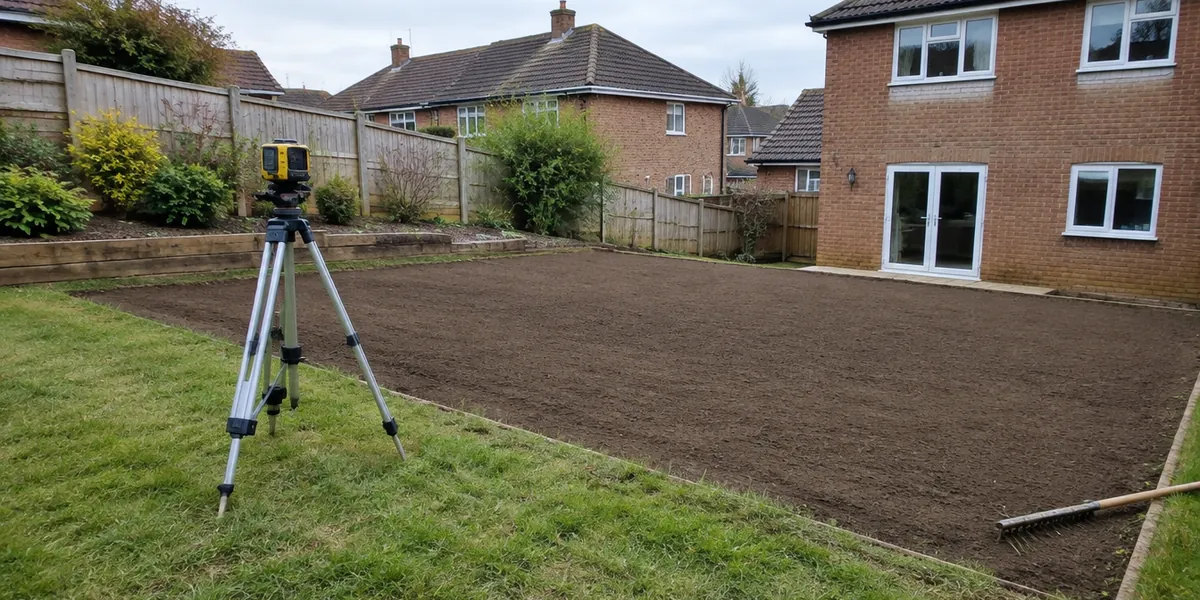
Levelling is measured work. We set out with a laser level and pegs, record existing levels, agree the finished levels with you, and then cut, fill and compact to hit them. Fill goes in layers, each compacted, so the ground does not sink later. Where a slope needs terracing we build the retaining structures first and grade behind them. Where a garden in Accrington collects water we grade a swale so it collects somewhere useful. All of it is quoted in writing with a levels drawing, and all of it is covered by a written guarantee.
Where We Offer Garden Regrading
Regrading is reshaping the whole plot or a large part of it. It is the right choice when a Accrington garden slopes towards the house, when builders have left the ground lumpy, when a steep plot needs level areas, or when a new patio, lawn or outbuilding needs a prepared base at a set height.
We start by surveying what is there. A grid of laser spot levels shows how much the ground falls and where, and from that we agree finished levels: typically a fall of about 1 in 60 away from the house for the first few metres, then whatever gentle gradient suits the rest, with low points arranged to meet a drain, soakaway or swale.
The work is cut and fill. High ground is excavated and the spoil moved to fill low ground where possible, which saves taking material off site and bringing new material in. Where the plot needs more than it has, we import clean topsoil or a graded fill. Fill is placed in layers no more than 150 mm thick and each layer is compacted with a plate compactor or roller before the next, so the finished surface stays where we put it.
On sloping plots regrading often means terracing: two or three level platforms stepped down the garden, held by sleeper, block or gabion retaining walls with drainage behind them. We strip and stockpile the good topsoil at the start and spread it back over the finished grade, so the garden can be planted or turfed straight away.
Lawn Levelling
Lawn levelling is the finer end of grading. The lawn is roughly where it should be, but the surface has dips and humps that make mowing a chore, hold puddles in winter and turn an ankle in summer. Many older lawns have both.
How we level depends on how bad it is. Shallow dips of 20 mm or so are treated by top-dressing: a mix of sharp sand and screened loam brushed into the hollows in thin layers, no more than 10 to 15 mm at a time, repeated through a growing season so the grass grows up through each layer. This keeps the existing lawn and is the least disruptive method.
Deeper hollows and pronounced humps need the turf lifted. We cut the turf in strips, roll it back, add or remove soil, compact and rake to the new level, then relay the same turf and water it in. We often combine lawn levelling with drainage installation where the hollows are also the wet spots.
What affects the result is compaction and timing. Levelling in April to September, while the grass is growing, lets top-dressing knit in and relaid turf root quickly; levelling a saturated lawn in midwinter damages the soil structure.
Drainage Swale Grading
A swale is a wide, shallow, grassed or planted channel shaped into the ground to collect run-off and either carry it slowly to an outlet or hold it while it soaks in. It costs far less than a piped system and looks like a gentle dip in the lawn rather than a ditch. Swales are increasingly used in UK gardens as part of SuDS thinking, keeping rainwater on the plot rather than sending it to an overloaded drain.
Swale grading is the right choice where a lawn or bed receives run-off from higher ground, paving or a neighbouring garden and there is room to shape a channel across its path. It also suits sites where a soakaway will not work because the subsoil is clay: a swale holds water on the surface and lets it evaporate and infiltrate slowly, with an overflow to a drain for the biggest storms.
We grade swales with a laser so they hold a consistent, very gentle fall, typically no steeper than 1 in 100, with side slopes shallow enough to mow, around 1 in 4 or flatter. Depth is usually 150 to 300 mm and width 1 to 2 m. The base is shaped, lightly compacted and then turfed or planted with moisture-tolerant grasses, sedges and perennials that can cope with occasional flooding and summer drought.
What affects the outcome is the fall and the overflow. A swale graded flat ponds at one end; one with no overflow floods in a cloudburst, so we shape a spill point at the downstream end to a gully, soakaway or ditch.
Erosion Control on Sloping Gardens
Levelling and regrading often go hand in hand with keeping soil where it belongs. On sloping Accrington gardens, bare banks wash out in heavy rain, so we finish regrading work with one or more of the measures below.
Erosion Control Matting
Matting is the quickest way to stop a bank losing soil. A mat pegged over the surface takes the impact of the rain, slows the water, holds seed and soil in place and keeps the surface moist enough for roots to get going. On most Accrington garden banks it is the first layer of a planting scheme, not a finish in itself.
We use biodegradable mats where plants will take over: open-weave jute for gentle slopes and seeded areas, and heavier coir for steeper banks and anywhere water runs across the surface. Both last two to three years before rotting away, by which time the planting should be established. For very steep banks, slopes under paths or areas that will stay bare, we use a long-life synthetic turf reinforcement mat or a cellular confinement grid filled with topsoil, which holds the soil permanently.
Slope Stabilisation Planting
Matting buys time; roots do the long-term work. Slope stabilisation planting puts in species chosen for their root systems, their tolerance of the slope's aspect and soil, and their ability to cover the ground quickly. Done well, it turns an eroding bank in a Accrington garden into a stable, low-maintenance planted slope that needs no further intervention.
The plant choice depends on the bank. For sunny, free-draining slopes we use deep-rooted grasses, thymes, rock roses, cotoneaster, broom and lavender. For shaded, damper banks we turn to periwinkle, ivy, ferns, hardy geraniums and spreading shrubs such as low-growing viburnum and spotted laurel. On larger banks small trees and shrubs with fibrous roots, such as willow, dogwood and hazel, are planted among ground cover.
Vegetated Buffer Planting
A vegetated buffer is a strip of dense, permanent planting placed where run-off needs slowing, filtering or absorbing. It sits along the bottom of a slope above a patio or path, along a boundary that receives water from a higher neighbour, or beside a ditch, pond or stream edge. The planting acts as a sieve: it slows water, drops the silt it is carrying, and takes up a good deal of the water itself.
In a Accrington garden a buffer might be a 1 to 2 m wide band of tough perennials, grasses and shrubs between a sloping lawn and a terrace, or a mixed native hedge and ground-cover strip along a boundary ditch. The plants are chosen to cope with wet feet in winter and drought in summer: sedges, rushes, purple moor grass, hemp agrimony, meadowsweet, dogwood and willow in the wettest positions; ornamental grasses, geraniums and shrub roses where it is drier.
Why Choose Us for Garden Levelling and Grading in Accrington
Levelling done by eye and left to settle is how gardens end up with a patio that puddles. Every job in Accrington is set out with a laser level, finished levels are agreed on a drawing before we start, and fill is compacted in layers so it stays put.
We do not bury rubble or builders' waste in the fill, and we are registered waste carriers, so what leaves the site leaves properly.
Because grading is usually the first stage of something, we design it for what follows: a patio base at the right depth, a lawn with a fall to a drain, a terrace ready for planting. Where the problem is really water in the ground rather than the shape of it, we will say so and suggest garden drainage installation; where a bank is losing soil we will recommend erosion control. Quotes are written and itemised, our team is insured, and the work carries a written guarantee.
Our Garden Levelling and Grading Process
- Survey. We take a grid of spot levels across the garden with a laser and note where water collects, where services run and where trees and boundaries constrain the work.
- Agree finished levels. You receive a simple levels drawing showing cut and fill areas, falls, any terraces and where water will go, with a written itemised quote.
- Strip and stockpile topsoil. Good topsoil is set aside so it can go back on top at the end.
- Cut and fill. High ground is excavated and used to fill low ground, with imported material brought in only where needed.
- Compact in layers. Fill is placed in 150 mm layers and each one compacted before the next, so the finished grade does not sink.
- Final grade and check. The surface is raked and rolled to the drawing, checked with the laser and a straightedge, and topsoil spread back.
- Finish. We turf, seed, plant or hand over a prepared base for the patio or building that follows.
A lawn levelling job in Accrington may take a day; a full regrade with terracing can take a week or more depending on the volume of soil moved.
What Affects the Cost of Garden Levelling and Grading in Accrington
The volume of soil moved is the main driver. Top-dressing a slightly bumpy lawn uses a few bags of sand and loam; regrading a sloping plot can mean tens of tonnes cut, moved and compacted. Whether cut and fill balance on site matters a great deal, because importing topsoil and removing spoil are both charged by the load.
Access decides whether we can use a mini excavator and dumper or must work by hand with barrows through the house, which changes the labour considerably. Retaining structures for terraces, with their drainage, are a cost in their own right and vary with height and material. Compaction, geotextile and drainage behind walls add to materials.
Ground conditions in Accrington play a part: heavy clay is slow to work and may need a drying period, while buried rubble, old foundations and roots take time to deal with. The finish you want, whether turf, seed, planting or a prepared base, is quoted as a separate item so you can see each element of the written quote.
Garden Levelling and Grading Around Accrington
We level and grade gardens throughout Accrington. If your plot in Oswaldtwistle or Church slopes, regrading and terracing can turn it into usable level space. If an older lawn in Clayton-le-Moors or Great Harwood has settled over former beds and paths, it is a typical lawn levelling job. Swale grading is increasingly asked for in Huncoat, and it suits any garden that takes run-off from higher ground. Wherever you are in Accrington or nearby Haslingden, Padiham and Rawtenstall, we can survey the levels and quote.
Planning more than one job? Have a look at garden drainage installation.
Common Questions
How much should a garden slope away from the house?
A fall of about 1 in 60, roughly 25 mm per 1.5 m, for the first few metres is the usual target, enough to shed water without being noticeable underfoot. Paving next to the house should finish at least 150 mm below the damp-proof course. Beyond that, a gentle gradient of 1 in 100 or so towards a drain, soakaway or swale is ideal for most Accrington gardens.
Can you level a lawn without digging it up?
Yes, if the dips are shallow. Top-dressing with a sand and loam mix in thin layers through the growing season fills hollows of up to around 20 mm without disturbing the turf. Deeper hollows and humps need the turf lifted and the soil beneath adjusted. We assess which method suits each Accrington lawn on the site visit and sometimes use both on the same garden.
Will the ground sink after regrading?
Not if fill is compacted properly. We place fill in layers of no more than 150 mm and compact each one with a plate compactor or roller before adding the next, which removes the voids that cause settlement. Loose fill tipped in and left to settle on its own is what causes sunken patios and dipping lawns a year later, and we do not work that way.
What is a drainage swale and will it look like a ditch?
A swale is a broad, shallow grassed or planted channel, usually 150 to 300 mm deep and 1 to 2 m wide, with side slopes gentle enough to mow. Shaped and planted well it reads as a soft dip in the lawn or a planted strip, not a ditch. It collects run-off and lets it soak away slowly, and it is one of the simplest SuDS features a Accrington garden can have.
Do I need planning permission to change the levels in my garden?
Minor regrading within a garden generally does not need permission. Raising ground significantly near a boundary, building retaining walls above around a metre next to a road or two metres elsewhere, or work in a conservation area or near a protected tree may need consent. We point out anything in Accrington that should be checked with the council before quoting.